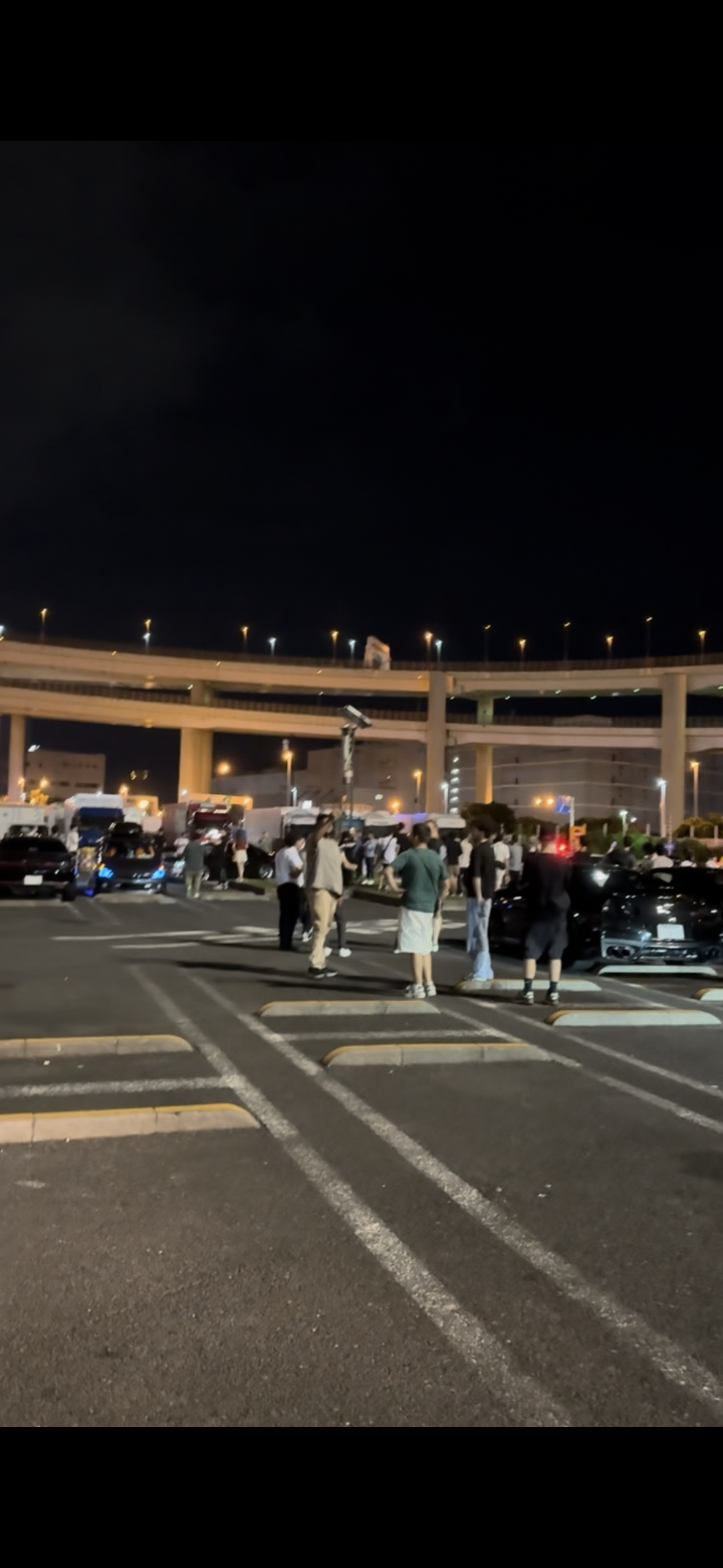
If you’re visiting Tokyo’s car scene for the first time, you’ll hear two names more than any other: Daikoku PA and Tatsumi PA. Both are on the Wangan. Both attract serious car people. However, they are completely different experiences — and knowing the difference will change how you plan your night.
Short answer: go to Daikoku first. But read on, because the full picture is more interesting than that.
The Fundamental Difference
Daikoku PA is the main event. It’s loud, unpredictable, and packed with every genre of car culture you can imagine — all in the same car park, on the same night. Furthermore, it sits inside a highway interchange structure, which means the setting itself is unlike anything you’ve seen before.
Tatsumi PA is the comedown. Smaller, quieter, more conversational. Where Daikoku is a spectacle, Tatsumi is a vibe. It’s where the night ends, not where it starts.
Neither is better. They serve completely different moods — and ideally, you visit both.
Daikoku PA — Everything, All at Once
The Basics
Daikoku Futo PA sits on the Bayshore Route (湾岸線) of the Metropolitan Expressway in Yokohama. Car only — there’s no train access. If you don’t have a rental car yet, get one. Taking a taxi from central Tokyo costs more than a day’s rental, so factor that in.
How to Get to Daikoku PA – JDM Pilgrim
What Shows Up
The short answer is everything. Supercars, JDM builds, drift cars, stance builds, American muscle, classic Kei cars — on any given night at Daikoku you’ll find genres that would never share a car park anywhere else in the world. In contrast to most car meets that attract a specific crowd, Daikoku is genuinely all-inclusive.
The crowd shifts depending on when you go:
- Weekday afternoons / evenings — More street-oriented, more JDM. Mondays in particular are notable because many Japanese mechanics have the day off, which means the people who actually build and maintain these cars show up in their own machines.
- Weekend daytime — All genres, including the supercar crowd. If Ferraris and GT-Rs in the same frame is what you’re after, weekend afternoons deliver.
- After midnight — The street scene takes over. Builds get more aggressive, the energy shifts, and unexpected things happen. Spontaneous burnouts. Police showing up. The kind of moments that don’t repeat.
The Facilities
Daikoku has food options, vending machines, and a convenience store. However, deep into the night only the vending machines and convenience store stay open. Plan accordingly — arriving hungry at 2AM means vending machine food.
Police and Closures
Friday, Saturday, and Sunday evenings from around 8PM bring police presence and periodic closures — the same pattern as Tatsumi. When Daikoku closes, the crowd often moves, only to return hours later. It’s part of the rhythm. Don’t leave permanently just because the police roll through.
The First-Timer Experience
Two things catch everyone off guard at Daikoku. First, the physical structure — you’re inside an elevated highway interchange, with roads curving overhead, concrete columns everywhere, and the sound of cars on the expressway above mixing with everything happening in the car park below. It’s surreal in the best way.
Second, the spontaneity. Something happens at Daikoku that doesn’t happen at organized events — because nothing is organized. A car you’ve never seen before rolls in at midnight. A burnout happens without warning. A crowd forms around a single build for reasons you can’t quite explain. Every visit is different, which is why regulars go back again and again.
Photography
Completely free. However, remember what you’re looking at: these are privately owned, personally built cars. For many owners, this is a machine they’ve spent years and significant money building — sometimes taken on debt to make it happen. Photograph freely, but approach with the respect that deserves.
Do not touch the cars without being invited. This applies everywhere in Japanese car culture, but at Daikoku where the builds are serious and the owners are proud, it matters especially.
Tatsumi PA — Where the Night Ends
The Basics
Tatsumi PA is also on the Bayshore Route, closer to central Tokyo. Car only. Same closure pattern as Daikoku — Friday, Saturday, and Sunday evenings from around 8PM. When Daikoku closes, Tatsumi often closes too, so if both are shut on the same night, that’s just how it is. Weeknights are more reliable for both.
Tatsumi PA — The Ultimate Guide to Tokyo’s Most Authentic Wangan Stop – JDM Pilgrim
What Shows Up
Tatsumi has Wangan roots — historically it was associated with the high-speed midnight crowd, the culture that inspired the manga and games. That era is largely gone, but the PA still attracts a grip-oriented, street-focused crowd. On a typical night you might find 10 cars. That’s not a disappointment — it’s the whole point.
The smaller scale means you’re not anonymous. People notice when a foreigner makes the effort to show up at Tatsumi, and the conversations that follow tend to be more genuine than anything you’ll have in a crowd of hundreds.
The Vibe
If Daikoku is upper energy, Tatsumi is chill. People lean on bonnets, talk, and take their time. The best conversations in Tokyo’s car scene happen at Tatsumi at 1AM when the night has already peaked and everyone who’s still there is there because they want to be.
Head-to-Head
| Daikoku PA | Tatsumi PA | |
|---|---|---|
| Location | Yokohama, Bayshore Route | Koto-ku Tokyo, Bayshore Route |
| Vibe | High energy, spectacle | Chill, conversational |
| Scale | 100+ cars on big nights | ~10 cars typical |
| Car Genres | Everything | Grip-oriented, street |
| Best Time | Weekday nights, after midnight | Late night any weekday |
| Closures | Fri/Sat/Sun from ~8PM | Same |
| Facilities | Convenience store, vending machines | Basic |
| Foreign Visitors | Very common | Rare |
| First Timer? | Go here first | Go here after Daikoku |
The Recommended Route
If you have one night: Daikoku. No question.
If you have more time — and you should, because Daikoku rewards repeat visits — the optimal route is:
Heiwajima PA → Tatsumi PA → Daikoku PA
Save Daikoku for last. Once you’ve experienced it, every other PA will feel smaller. By doing Tatsumi and Heiwajima first, you build context for what makes Daikoku special. And when you finally pull into Daikoku at midnight and see what’s there — you’ll understand why people drive from all over Japan to be in that car park.
One more thing: don’t try to do all three in one night on your first visit. Give each place the time it deserves.
The One Rule That Applies to Both
The cars in these car parks belong to real people. Not display models, not press cars — privately owned machines that represent years of work, passion, and in many cases real financial sacrifice. Some of the builds you’ll see took debt to achieve.
Look freely. Photograph everything. Talk to owners if they’re open to it. However, never touch a car without being invited to. That boundary is absolute, and respecting it is the difference between being welcome and not.
Getting There
Both PAs are only accessible by car — no train access to either. Rent a car, use the Metropolitan Expressway Bayshore Route (湾岸線), and navigate to each PA from there.
Taking a taxi from central Tokyo to Daikoku costs more than renting a car for the day. Get the rental.
New to renting a car in Japan? Read our complete guide: How to Rent a Car in Japan
The Bottom Line
Daikoku PA is one of the greatest car culture destinations on Earth. Tatsumi PA is where you go when you want something more real. Both are worth your time, and together they give you the full picture of what Tokyo’s Wangan scene actually looks like.
Go to Daikoku first. Go back multiple times. End your nights at Tatsumi. That’s the move.