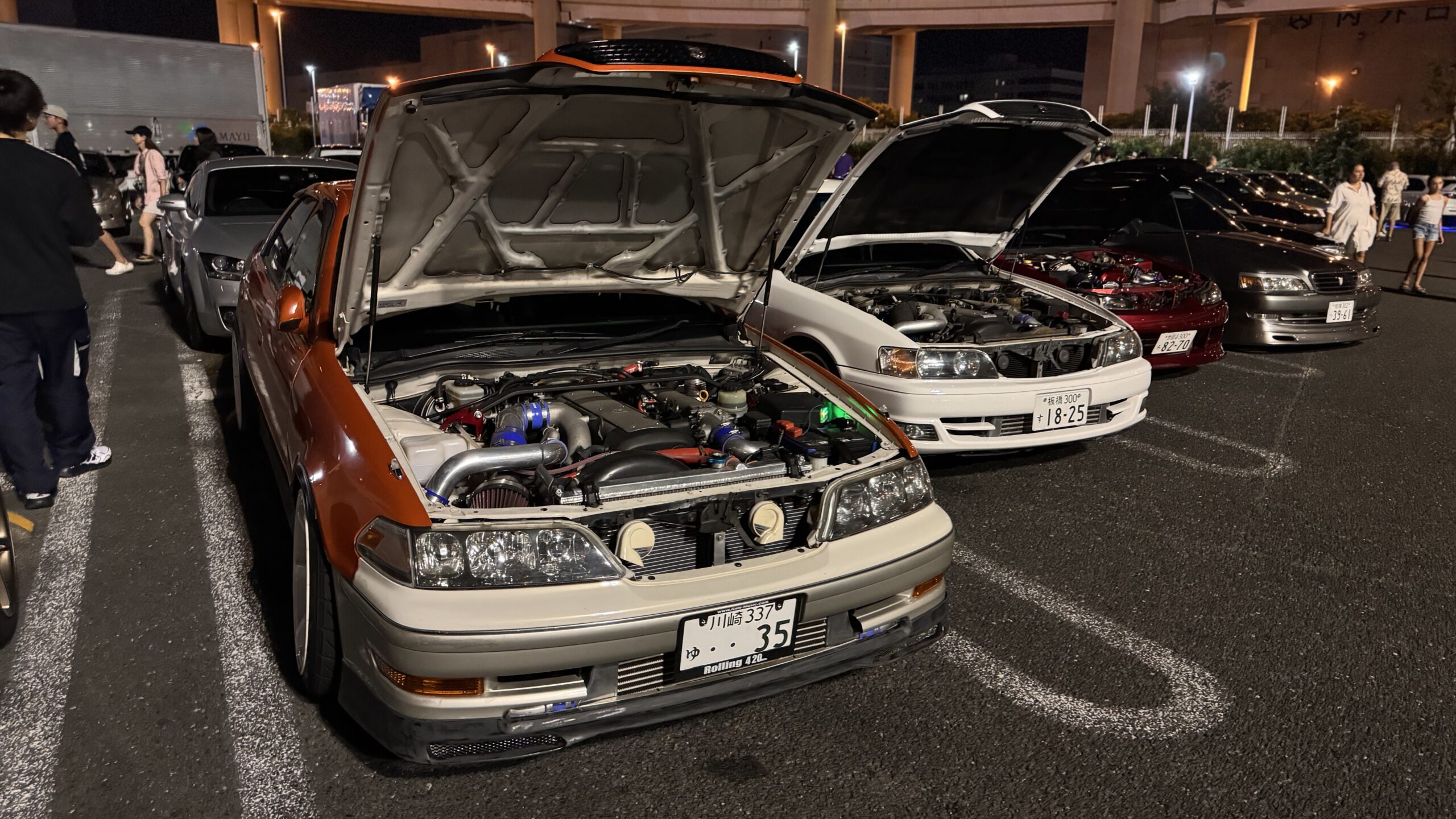
Japan’s car meet scene is one of the most welcoming in the world — but only if you know how to show up. The rules aren’t complicated, and most of them come down to one principle: treat every car like it belongs to someone who loves it more than anything else they own. Because it probably does.
This guide pulls together everything you need to know before your first Japanese car meet, whether you’re heading to Daikoku PA, Shibuya Carjack, or anywhere in between.
The One Rule That Covers Everything
Before the specifics: if you’re ever unsure whether something is okay, ask yourself — “Would I want someone doing this to my car?”
That single question covers 90% of situations. Japan’s car community runs on mutual respect, and the people you’ll meet have often spent years and serious money building what you’re looking at. Some are still paying for it. Act accordingly.
Don’t Touch the Cars
This is the most important rule, and it applies everywhere in Japan without exception.
Do not touch, lean on, open, or sit in anyone’s car without being explicitly invited to do so. It doesn’t matter how impressive the build is, how much you want a closer look, or how friendly the owner seems. Wait to be invited.
If an owner pops the hood or opens a door, that’s your invitation. Until then, keep your hands to yourself.
Photography — Free, But Do It Right
Photography is generally fine at Japanese car meets. However, how you do it matters as much as whether you do it.
Don’t silently point a camera at someone’s car from a distance and walk away. Make eye contact, show enthusiasm, give a thumbs up. A genuine reaction — even without shared language — goes a long way. Owners notice the difference between someone who’s genuinely excited about their build and someone who’s just collecting photos.
For cars at illegal or semi-legal meets: don’t post online immediately after the event. This is one of the most important unwritten rules in Japan’s car culture. Wait. Let the night pass before anything goes on social media. Posting in real time can end the event for everyone, and you’ll quickly become unwelcome.
Communication — Language Is Not a Barrier
Most Japanese car enthusiasts don’t speak conversational English. However, most of them studied English for around six years in school — which means if you speak slowly and clearly, more gets through than you’d expect.
For everything else: use a translation app. Pull out your phone, type what you want to say, and show them the screen. It’s not awkward — it’s practical, and people appreciate the effort. Google Translate’s camera mode also works well for reading Japanese signs and stickers on builds.
The best conversation starter: if you drive a JDM car back home, say so. Tell them what you drive. Show them a photo. This works better than any icebreaker — Japanese car owners genuinely light up when a foreigner tells them they’re running the same platform on the other side of the world. It creates an instant connection that transcends the language barrier completely.
Approaching Cars and Owners
Walking up to look at someone’s car is completely fine — there’s no need to hang back or ask permission just to look. Car meets exist precisely for this.
The key is awareness. Read the situation. If an owner is in the middle of a conversation, don’t interrupt. If someone is clearly not in the mood for interaction, respect that. And when you do approach, do it with visible enthusiasm — make it obvious you’re there because you love cars, not just because you’re a tourist passing through.
If You’re Arriving by Car
Large Meets (Daikoku PA, Odaiba, etc.)
Arriving by rental car is fine at larger meets. However, do not park your rental car among the modified builds. JDM cars line up together. A stock rental in the middle of that lineup is a clear etiquette violation — find a separate area of the car park for standard vehicles.
Smaller or Street Meets (Shibuya Carjack, etc.)
At tighter locations, park nearby rather than in the meet itself. Find a legal parking spot a short walk away, then walk in. Don’t try to squeeze a rental into a space that’s clearly part of the meet.
Engine and Noise
Turn your engine off when you’re parked. If your car is stock or near-stock, leaving it idling is generally fine. If it’s modified and loud, shut it down — unnecessary noise in a residential or enclosed area reflects badly on the whole scene.
When the Police Show Up
At some point, police will show up. It happens at Daikoku, Tatsumi, Shibuya Carjack — nearly everywhere. Here’s how to handle it:
Stay calm. Do not run.
Panicking and driving away fast is the worst thing you can do. It draws attention, creates danger, and makes the situation worse for everyone. When police arrive and ask people to move on, comply quietly and without drama. The meet will likely reconvene somewhere else, or the same spot will come back to life an hour later. It’s part of the rhythm — not the end of the night.
The Driving Rules — Don’t Get This Wrong
This is where foreign visitors make the most serious mistakes.
You need an International Driving Permit (IDP) to drive in Japan. Your home country license alone is not valid. If you’re driving without one and police are present — and at car meets, they often are — you will be stopped, and the consequences are significant.
Beyond the permit: Japan drives on the left side of the road, and traffic regulations are strictly enforced. Speed limits, lane discipline, and road rules are taken seriously in ways that might feel unfamiliar if you’re used to driving in other countries. Take the first few kilometers slowly, get comfortable with the road, and don’t let the excitement of the night push you into doing something you can’t take back.
Don’t have an IDP yet? Read our full rental car guide before your trip.
Stay Aware of Your Surroundings
The energy at a good car meet is infectious. It’s easy to get completely absorbed — and that’s fine, that’s the whole point. However, the best people at these events are always aware of what’s happening around them.
Watch where you’re standing. Be conscious of cars moving in and out. Don’t block exits or access routes. Keep an eye on the general atmosphere — if things start to feel tense or something seems off, trust that instinct and give yourself space.
The simple rule: enjoy everything, but stay present. If you do that, you’ll be fine anywhere in Japan’s car scene.
Quick Reference
| Rule | Details |
|---|---|
| Touching cars | Never without invitation |
| Photography | OK — show enthusiasm, don’t post illegal meets immediately |
| Language | Speak slowly, use translation app, show your own JDM car |
| Arriving by rental | Fine at large meets — don’t park among modified cars |
| Engine on | Turn off when parked, unless fully stock |
| Police | Stay calm, comply quietly, don’t run |
| IDP | Mandatory — get it before you leave your country |
| Driving side | Left — take it slow at first |
| Universal rule | Would you want this done to your car? |
The Bottom Line
Japan’s car meet scene will give you some of the best experiences you’ve ever had around cars. The community is open, the builds are incredible, and the culture runs deeper than almost anywhere else in the world.
None of the rules here are difficult. Show respect, use common sense, and approach everything with genuine enthusiasm for the cars — not just as a spectator experience, but as a culture worth understanding. Do that, and you’ll be welcomed back every time.