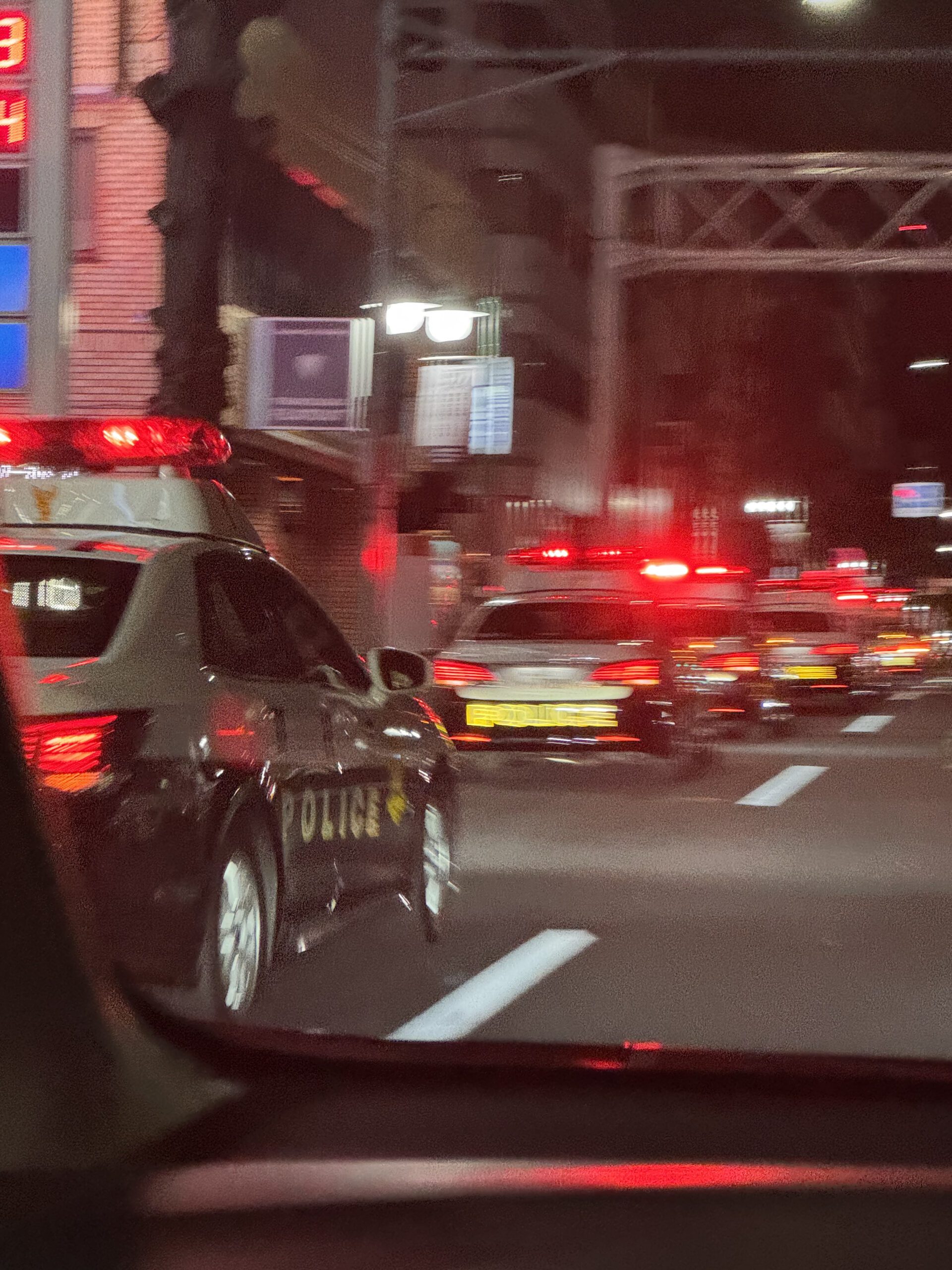
Let’s get this out of the way first: Japanese police are not your enemy. They’re generally polite, professional, and surprisingly relaxed about the whole thing — especially with foreigners. However, there are a few things that can turn a routine interaction into a very long night, and this guide exists so you don’t accidentally make those mistakes.
One personal data point: the author of this site was stopped four times in a single day in Shibuya. By the fourth stop, the officers already knew the name and face. Everything was fine. That’s the level of drama we’re talking about.
The Complete Guide to Japanese Car Meet Etiquette – JDM Pilgrim
Why You Might Get Stopped in Japan
Japan is an extraordinarily homogeneous country. Outside of tourist areas, seeing a foreign face is genuinely unusual — and unusual things attract attention, including from police.
If you’re at Daikoku PA or Shibuya Carjack, you’re in a crowd and largely anonymous. However, if you’re walking through a residential neighborhood, parked in an industrial area late at night, or anywhere that isn’t an obvious tourist destination, the probability of a 職務質問 (shokumu shitsumon) — a police stop and questioning — goes up significantly. In some areas, foreign visitors get stopped roughly once a week.
This isn’t hostility. It’s curiosity combined with procedure. The important thing is knowing how to handle it.
What Happens When Police Stop You
On Foot
An officer will approach, show their badge, and ask some questions. They want to know who you are, where you’re from, and what you’re doing. That’s it.
While Driving
If you’re pulled over while driving, you’ll be asked to present:
- Your passport
- Your home country driver’s license
- Your International Driving Permit (IDP)
Have all three accessible. Hand them over without being asked twice.
The Part That Will Surprise You
Here’s something nobody tells foreign visitors: even if you’ve technically broken a traffic law, the chances of actually receiving a fine are low.
Japanese law doesn’t have a particularly strong enforcement mechanism for issuing fines to foreign visitors — because fines are typically sent by post to a Japanese address, and you don’t have one. No address to send the notice to means, in many cases, a warning and nothing more.
This is not an invitation to drive however you want. However, it does mean that if you get pulled over for a minor infraction, there’s no need to panic. Stay calm, be cooperative, and in most cases you’ll be back on your way with nothing more than a lecture you didn’t fully understand.
Can You Refuse a Police Stop?
Technically, yes — Japanese law does allow you to decline a 職務質問. In practice, no.
Refusing or being uncooperative is one of the fastest ways to escalate a routine stop into something much worse. Decline once and you might find ten officers surrounding you within minutes, even if you’ve done absolutely nothing wrong. The legal right to refuse exists on paper. In reality, it’s not a road worth taking.
Cooperate. Be friendly. It ends faster and better every single time.
At a Car Meet — How to Handle Police Presence
Police showing up at a car meet is not an emergency. It’s a Tuesday. Here’s the protocol:
Do not run. This cannot be stressed enough. Running — or driving away quickly — immediately signals that you have something to hide. In Japan, that level of panic response is associated with drug offenses. What started as a routine dispersal becomes a pursuit. The police had no intention of detaining anyone, and now they do. You caused that.
Stay calm, comply, and be friendly. Officers at car meets are usually there to move people along, not to arrest anyone. Smile, nod, start your engine, and leave at a normal pace. That’s all that’s required.
Don’t be the reason the meet ends permanently. Car meets exist in a delicate balance with local authorities. Incidents caused by panicking foreigners are exactly the kind of thing that gets a location shut down for good.
The One Thing That Can Actually Ruin Your Trip
Everything above is manageable. This is not:
Driving without an International Driving Permit.
No IDP means you’re driving illegally in Japan, full stop. Unlike minor traffic violations, driving without proper licensing is treated seriously — it can result in court proceedings, not just a warning. The friendly, flexible attitude Japanese police show toward foreign visitors does not extend to this.
Get your IDP before you leave your home country. It takes a few days and costs around $20. There is no version of this where skipping it is worth the risk.
Dealing With the Language Gap
Japanese police officers generally don’t speak English. However, most studied it for years in school, so speaking slowly and clearly helps more than you’d expect.
For everything beyond basic communication: translation app, phone screen facing them. It’s practical, not awkward, and officers are used to it with foreign visitors.
The universal language that works everywhere: calm, cooperative body language. Hands visible, no sudden movements, relaxed demeanor. That communicates more than any vocabulary.
Quick Reference
| Situation | What To Do |
|---|---|
| Stopped on foot | Cooperate, show passport if asked |
| Pulled over driving | Passport + home license + IDP, hand over immediately |
| At a car meet when police arrive | Stay calm, leave slowly, do not run |
| Minor traffic violation | Cooperate — fines rarely stick for foreign visitors |
| No IDP | This is serious — don’t drive without one |
| Refusing questioning | Legal in theory, catastrophic in practice — don’t |
| Language barrier | Speak slowly, use translation app |
The Bottom Line
Japanese police are, on balance, some of the most professional and reasonable law enforcement you’ll encounter anywhere in the world — especially toward foreign visitors. The system works in your favor as long as you don’t fight it.
Be cooperative. Be friendly. Have your documents ready. Don’t run.
Do those four things and the worst outcome of any police interaction in Japan is a slightly awkward conversation and a delayed night out.
Heading to a car meet? Read our complete etiquette guide first — knowing how to conduct yourself goes a long way before the police even enter the picture.
コメントを残す