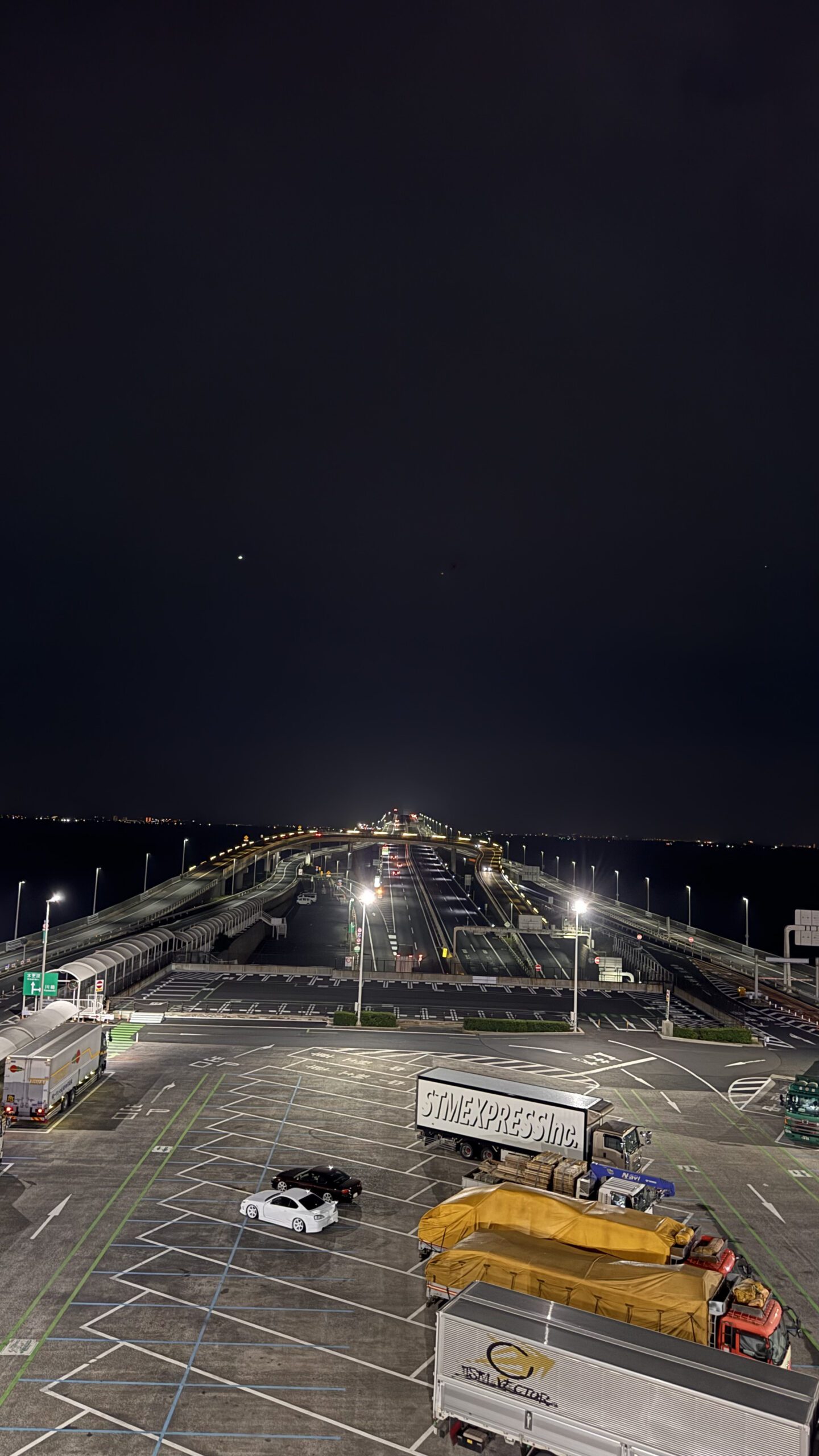
If Daikoku is Tokyo’s most famous car meet, Umihotaru is its most dramatic. Built on an artificial island in the middle of Tokyo Bay, this highway rest stop doubles as one of Japan’s best JDM gathering spots — and the setting alone makes it unlike anywhere else in the world.
I’ve been out here late on a Saturday night. Here’s what you need to know.
What Makes Umihotaru Different
Umihotaru Parking Area sits in the middle of Tokyo Bay. Not near the water — on it. It’s a man-made island roughly halfway along the Tokyo Bay Aqua-Line, a combined tunnel-and-bridge expressway connecting Kanagawa and Chiba prefectures.
There is nowhere else like this. A highway rest stop surrounded by ocean on all sides, with the glow of the city visible in the distance. On a clear night, the views across the bay are genuinely stunning.
Now add a few hundred JDM cars parked up under those lights. That’s Umihotaru on a good Saturday night.
The Cars
The scene here is JDM-focused. Unlike Daikoku’s anything-goes mix of Italian exotics and supercars alongside domestic builds, Umihotaru tends to draw the JDM crowd — which, depending on what you’re there for, is exactly the point.
The scale is comparable to Daikoku. On a busy night, you’re not looking at a handful of cars — you’re looking at a proper gathering spread across the lot.
One Thing to Know: The Truck Parking Area
This is important and you won’t find it in most guides.
When a JDM-specific event or organized meet is happening at Umihotaru, the cars don’t always gather in the main parking area. They move to the truck parking section. If you pull into the main lot and wonder where everyone went, that’s your answer. Walk over to the truck area.
Getting There
Umihotaru is only accessible by car via the Tokyo Bay Aqua-Line. There is no train, no bus, no other way in.
From central Tokyo, take the expressway to the Bayshore Route (湾岸線), then onto the Aqua-Line. Umihotaru is the rest stop roughly in the middle of the crossing. You cannot miss it — it’s the only stop on the route.
Drivers coming from Chiba also use the Aqua-Line from the opposite direction, so the lot draws from both sides of the bay.
Parking is free. It’s a highway PA — no extra fees beyond your expressway toll.
When to Go
Saturday night, around 10:00 PM. That’s when things are properly going.
For many regulars, Umihotaru is the second stop of the night. The typical flow: start at Daikoku PA in Yokohama, stay until the lot closes, then head to Umihotaru to keep the night going. If you’re already at Daikoku when it shuts down, this is the natural next move — and you’ll find plenty of people making the same drive.
Earlier in the evening the lot fills up with regular travelers and tourists taking in the view. By the time you arrive around 10:00 PM, the balance has shifted and the car crowd takes over.
Closures — Read This First
Umihotaru shuts down, and it happens regularly.
The pattern to know: when Daikoku closes on a Saturday night, Umihotaru often closes at the same time. Both lots fill beyond capacity on busy weekends, and management shuts them to new traffic simultaneously.
Before you get on the Aqua-Line, check the electronic signboards at the expressway entrance. Closure information is displayed there in real time. If the sign shows Umihotaru is closed, it means the lot is full and you won’t be getting in — save yourself the toll and turn around.
Don’t skip this step. The Aqua-Line toll is not cheap, and there’s no reason to pay it for a closed PA.
Etiquette
The same rules that apply at every Japanese car meet apply here. For the full breakdown, read our guide to Japanese car meet etiquette.
The short version: don’t touch cars, ask before you photograph, and talk to people. The Umihotaru crowd is the same community you’ll find at Daikoku — respectful, passionate about their cars, and more open to conversation than you might expect.
Quick Info
Location: Umihotaru PA, Tokyo Bay Aqua-Line, midpoint between Kanagawa and Chiba
Access: Car only via the Tokyo Bay Aqua-Line (湾岸線 → アクアライン)
Best night: Saturday
Best arrival time: Around 10:00 PM
Cost: Free parking. Standard expressway tolls apply.
Closure check: Look for the electronic signboards at the expressway entrance before you get on